
You’ve probably heard that pulling money from a pre-tax 401(k) or IRA before 59½ comes with a 10% penalty (on top of taxes).
Luckily, there’s a strategy that can help avoid the 10%, and is especially helpful for someone looking to retire early (e.g. say at 50)
IRC 72(t)(2)(A)(iv) waives the 10% penalty if, instead of a 1 time withdrawal, you commit to a “series of substantially equal periodic payments” (SoSEPP) based on your life expectancy.
Basically, you would now have to follow a specific schedule, instead of pulling money from this account. There is no minimum age to start. However, the younger you start, the longer you are locked into the schedule.
There are 4 inputs needed to determine the withdrawal amount per IRS Notice 2022-6:
1. Interest rate
The maximum rate you’re allowed to use is the greater of 5%, or 120% of the federal mid-term rate for either of the 2 months before your first payment. So if you’re starting in July, you’d compare 120% of June’s rate, 120% of May’s rate, and 5%, then use the highest of the 3.
Rates are published in the “Applicable Federal Rates” and change monthly. Most people use the max since a higher rate produces a larger payment, but you can use a lower rate if you want smaller withdrawals.
2. Life expectancy
Pick one of three IRS tables: the Uniform Lifetime Table (Appendix A of Notice 2022-6), the Single Life Table, or the Joint and Last Survivor Table (both under §1.401(a)(9)-9). The Single Life Table generally produces the highest withdrawal.
3. Method
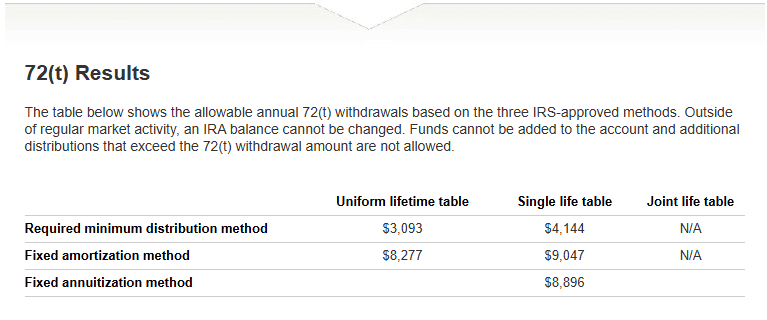
Minimum Distribution Method. This one is probably the worst one, since it’s a variable and you have to recalculate the amount every year.
Amortization Method. Fixed withdrawal
Annuity Method. Fixed withdrawal
I would choose Amortization or Annuity as it’s a set it once.
4. Account balance
Only the account you designate is subject to the rule, and it needs to stay “clean” (no outside contributions and no withdrawals beyond the scheduled payments)
Something to consider is to create a separate IRA, and roll the portion you want to use towards the 72(t) and keep the other account as is.
An important catch is that once you start, you are locked in for the longer of 5 years or until you hit 59½. Modification would generally trigger the retroactive penalty of 10% to everything you withdrew.
For example, say you have $200,000 in an IRA.
You decided that you want only $150,000 to be subject to the 72(t). You decided to use 5% as the interest rate and are 50 years old.
a 72(t) calculator puts the annual payment at roughly $9,000/year, scheduled every year until you hit 59½.
However, you have to document everything correctly, re-run the numbers using actual IRS tables before committing. Contract a qualified CPA to run the numbers for your specific scenario.
When taxes are filed, withdrawals would have to be reported on Form 5329 (line 2 needs to have a 02 code = substantially equal periodic payments).
The overall concept is simple, but the lock-in makes this a tricky strategy. You have to plan really well, and get a CPA to check your numbers before you start the clock, since an early exit means the IRS claws back the penalty on everything you’ve withdrawn.
See you next Saturday.