
An acquaintance of mine reached out saying that he maxed out his 401(k) and is investing in a brokerage account. I asked why he doesn’t invest in a Roth IRA too, to which he said “I’m over the income limit”
It still surprises me how many high earners don’t know about the Backdoor Roth.
I wrote about it a few times, but it’s a helpful reminder, especially now so that you can execute this for the year. By the way, I also wrote a full free guide that describes this a bit more in depth than this newsletter will, so check it out if you want.
For 2026, if you are filing your taxes as single and make more than $168,000 ($252,000 if married filing jointly) of modified adjusted gross income, you can’t contribute to Roth IRA.
Luckily, there is a strategy that allows you to contribute indirectly (or the “backdoor” way).
Backdoor Roth
Backdoor Roth is a strategy that allows high-income earners to contribute to a Roth IRA through a conversion process. The idea is simple: instead of contributing to a Roth IRA, you contribute to a Traditional IRA first and then convert the contributed amount to a Roth IRA.
Before I dive into the strategy, let me give a bit of background on how this strategy came to exist.
Prior to January 1, 2010, you could only convert from a Traditional IRA to a Roth IRA if your adjusted gross income was $100,000 or less. Luckily, after 2010 this income condition was eliminated, which is how the Backdoor Roth came to exist indirectly.
Here is a step-by-step guide:
1. Eliminate traditional IRAs balances
The first step is to roll over all your Traditional IRA, Rollover IRA, Traditional SEP, and Traditional SIMPLE IRAs into 401(k) or 403(b) plans before December 31, 2026. This is because if these accounts don’t have a $0 balance, you will be subject to the pro-rata rule on your conversion. Do this now before reading anything further.
If you are a solo business owner, you can also roll over these accounts into a Solo 401(k). If you don’t have 401(k) or 403(b) plans available to roll over into, there isn’t much you can do and you should generally avoid this strategy. You could potentially explore a Solo 401(k) for your side hustle, which may allow you to roll over these balances into it.
If you are doing the Backdoor Roth process but get laid off during the year, do not roll over the 401(k) or 403(b) balances into an IRA.
2. Make a non-deductinle contribution to a Traditional IRA
The next step is to contribute to a Traditional IRA. This contribution will be non-deductible. If you don’t have a Traditional IRA account, open one. Fund it with however much you want to contribute, up to the $7,500 limit for 2026.
Note: You or your spouse need to have earned income, such as wages or self-employment income, to contribute (same rule as a direct Roth IRA contribution), even if you are using the Backdoor Roth process.
3. Wait once the money settles
It usually takes a few days for your money to clear the bank and settle in your Traditional IRA. It’s generally recommended not to buy any stocks or ETFs within the account itself. That step should be done after the conversion.
4. Convert to a Roth IRA
Now, you will need to have a Roth IRA account to which you will convert your contribution. It will be easier if both accounts (Roth and Traditional) are with the same broker (e.g. Vanguard, Fidelity and so on), as this will simplify the conversion process.
You can typically complete the conversion online, or you can call your broker and ask them to process the conversion.
Here’s an example of the online conversion:
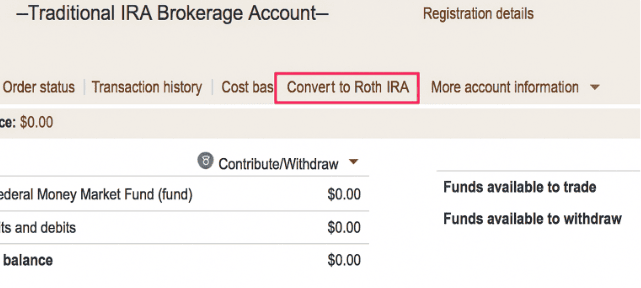
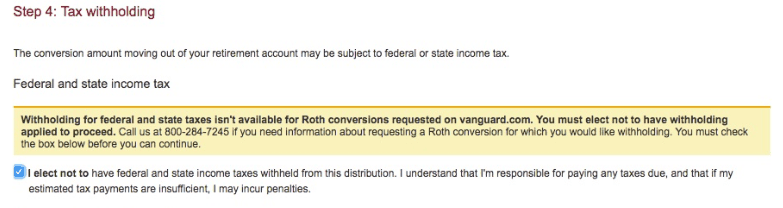
As part of the process, you will be asked if you want to have any taxes withheld. Make sure to elect not to have any state or local taxes withheld from the conversion.
5. Invest within the Roth IRA
Now that the money is within your Roth IRA, don’t forget to invest it!
6. Notes
It’s generally best to complete both the contribution and conversion within the same calendar year. For example, say you contribute $7,500 for 2026 on 7/25/2026. The money settles in the account on 7/27/2026, and you convert on 7/27/2026 (asap).
This is a “clean” conversion and will be easily reported on your tax return.
7. Tax time
During tax time, you will receive quite a bit of paperwork (Form 1099-R, Form 5498). You need to make sure you enter it correctly in the tax software, or, if you are using a CPA, double-check their work. If you are using a CPA, make sure to tell them that you did a Backdoor Roth for the year.
With your 1040 tax return, you will need to file Form 8606.
Specifically, you will need Parts I and II. Part I will show that you’ve made a non-deductible contribution, and Part II will show your conversion to Roth. Line 18 of Form 8606 should be $0 or just a few dollars of earnings (if you converted more than the original contribution). My guide has some examples of such contributions if you want to learn more in depth.
I hope you learned something new today.
See you next Saturday!