

Before the year ends, I wanted to cover a great concept – tax-loss harvesting.
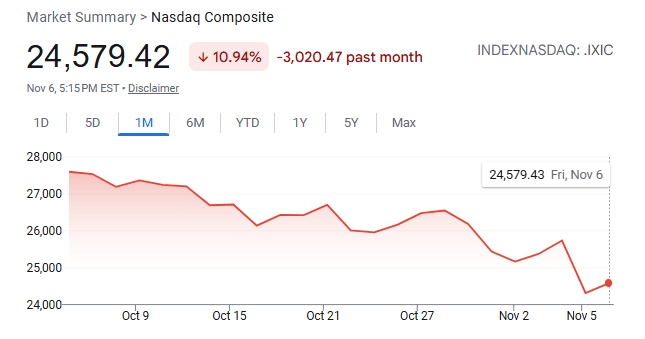
Especially considering the performance of the stock market. For example, NASDAQ is down ~11% over the last month.
So tax loss harvesting is a strategy to lower your tax liability by selling investments and repurchasing a similar one. The loss can be used to cancel out gains from other investments, which helps reduce the taxes you owe. Or you can use up to $3,000 of those losses each year to lower your taxable income if you don’t have any gains for the year.
Here’s the key goal of the tax-loss harvesting strategy:
Swap assets into similar, but not substantially identical funds, so you’re not really out of the market or changing your allocation strategy, but you can still harvest the losses for tax purposes.
Important part
Here’s the main requirement of tax-loss harvesting:
You cannot buy a “substantially identical” security or ETF, otherwise, your loss will be subject to a “wash sale” and will not be deductible.
But what is actually “substantially identical”?
The IRS has never provided any guidance on what “substantially identical” means. There is also a lack of court cases challenging any positions related to “substantially identical.”
For example, say John belives that VTI and VOO are not substantially identical because:
- VTI holds 3,000+ stocks vs. 505 of VOO
- They track different indexes (VTI tracks the US Market Index vs. VOO tracking the S&P 500)
While their performance is similar, it’s not substantially identical.
If the IRS audited John, they could argue that John lacked an economic move that had risk, since the transaction could not be primarily motivated by tax rules. To which John could technically answer, “I decided to rebalance into VTI to gain exposure to small market cap companies.”
Some CPAs make an argument that if two funds have 70% or less overlap, they aren’t substantially identical. Others argue that as long as it’s 90% or less, it’s not substantially identical (for clarify, VTI and VOO have 88% overlap)
While I’m not your CPA, and can’t advise you on the specifics of your case, or the “risk” you are willing to take with your tax position, here are some facts I do believe:
- Two stocks of two different companies are not considered substantially identical
- In terms of funds, if they track an identical index (e.g., S&P 500), even though they are different companies managing the funds (e.g. VOO, Vanguard’s S&P 500 fund, vs. SPY, State Street’s S&P 500 fund), I believe an argument could be made that they are substantially identical, even though some “robo-advisor” companies may disagree
Benefits
The best time to engage in tax-loss harvesting is when your tax rate is the highest. For example, if your marginal tax rate is 37%, you would essentially save 37% on taxes for every $1 of loss (up to $3,000) on the federal side. There could be savings on the state side too.
Another benefit related to tax-loss harvesting is the opportunity cost. When you save money on taxes and invest that savings instead of spending it (or paying it), that money can start earning returns too. Over time, your tax savings can earn more returns. So $1,110 of tax savings (assuming 37%) now could grow into a substantial amount over time.
Note that the tax-loss harvesting strategy “resets” the cost basis. So if you sell a fund at say $200 per share after originally buying it as $250 per share, the next ETF or stock purchase will have a cost basis that is $50 lower. This could result in higher capital gains later on when you sell the “re-purchased” stock or ETF.
However, generally, it can be managed if:
- You pass down the brokerage account to your children. They will inherit the account, receive a step-up in basis, and eliminate any capital gains.
- You sell during retirement when you ideally would have a lower income and can harvest these gains at a 0% long-term capital gains bracket (~$49k of taxable income for single filers, or ~$98k for married filing jointly).
Rules
Practically, you also need to understand your method, account, and timing when executing tax-loss harvesting.
1. Cost basis method
Before you sell, you need to understand your cost basis method. The options include FIFO (First In, First Out), LIFO (Last In, First Out), and specific identification. This is especially important if you’ve been buying the same stock for many years and want to sell only the most recently purchased shares.
The best cost basis method for tax-loss harvesting purposes is specific identification, as it allows you to select exactly which shares you want to sell.
2. Account & timing
It will be considered a wash sale if you buy any shares of the same ETF in a taxable account or IRA within the 30 days before or after the sale. You can always repurchase the exact same ETF on the 31st day, even if it’s substantially identical, because the wash sale rule wouldn’t apply after that period.
You cannot buy the same fund you sold in any of your accounts. For example, you cannot sell VOO in your taxable account and then buy VOO in your IRA the next day; otherwise, the loss will also be subject to a wash sale.
A good way to avoid this is to buy different funds across your accounts so there is no risk of triggering the rule. This also applies across different brokers you might have (e.g. Vanguard, Fidelity).
3. Dividend reinvesting
Lastly, it’s generally recommended to turn off automatic dividend reinvestment. Dividend reinvestment will trigger a purchase of the fund, and the newly purchased shares will be subject to the wash sale rule unless you sell them as well.
Another thing to mention about this topic is that cryptocurrencies are not part of the “wash sale” rules since they are not securities, and the IRS treats cryptocurrency as property. This means that you can sell at a loss and rebuy coins without impacting your wash sale rules, if that fits into your overall asset allocation strategy.
Have you done any tax loss harvesting? Feel free to reply to this email and let me know!
Chat next week!
Bo, CPA