

Section 415(d) of the IRC requires the Secretary of the Treasury (IRS) to annually adjust limitations for cost-of-living increases. So, let’s dive into some of the changes for 2027:
401(k), 403(b) and most 457 plans
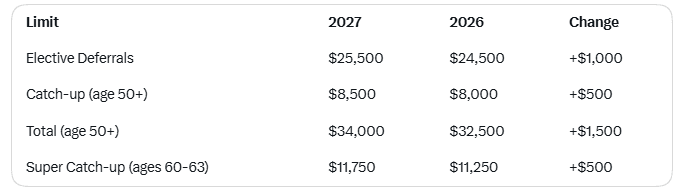
For 2027, the 401(k)/403(b)/457(b) amount you can contribute is increasing from $24,500 to $25,500. If you are in a 24% marginal tax rate, that’s an additional $240 of federal taxes you can defer. If you are over age 50, the catch-up contributions are also increasing from $8,000 to $8,500.
Defined Contribution Plans, §415(c)
The annual total contribution limit is increasing to $75,000 (up from $72,000)
This means that your employee contributions + employer contributions + after-tax contributions cannot exceed $75,000 in 2027.
Many people only have employee + employer contributions, but if you are self-employed with a Solo 401(k) or working for a big Fortune 500 tech company, you may have the option of making after-tax contributions. The strategy is called the “Mega Backdoor Roth,” which allows you to contribute thousands extra into your Roth 401(k)/Roth IRA.
IRAs (Traditional & Roth)

For 2027, the Roth/Traditional IRA limits remain $7,500.
Note that the Roth IRA income limits to contribute are also increasing in 2027. Direct Roth IRA contributions aren’t allowed if your modified adjusted gross income is over $173,000 (single) or $260,000 (married filing jointly) (phase-out ranges of $158,000-$173,000 single and $250,000-$260,000 MFJ).
However, you can still use the “Backdoor Roth” strategy to get around these income limits by doing a non-deductible IRA contribution that gets converted into a Roth. Just make sure you are aware of the pro-rata rule.
Other Adjustments:
IRS released more details on other key adjustments for 2027:
- Standard deduction
Married filing jointly: $33,200
Single: $16,600
Heads of households: $24,925
- Estate tax exclusion
The estate tax basic exclusion amount is $15,480,000 for 2027
- HSA
In 2027, you can contribute up to $4,500 if you are covered by a high-deductible health plan just for yourself, or $9,000 if you have coverage for your family
- Tax Brackets
All tax bracket limits are increasing. Here are the 2027 brackets for married couples filing jointly:
- 10% on taxable income not over $25,600
- 12% for incomes over $25,600
- 22% for incomes over $104,050
- 24% for incomes over $218,250
- 32% for incomes over $416,650
- 35% for incomes over $529,100
- 37% for incomes over $793,650
(For single filers the 37% rate begins over $396,825, otherwise divide the numbers by 2)
- QCD
The QCD limit (age 70½+) is also increasing to $114,000 (from $111,000), which is the maximum charitable gift from an IRA that can be excluded from your income.
So overall, most of the deductions or limits are increasing for 2027.
Take advantage of these limits and maximize your tax-efficient retirement savings!
Chat next week!
Bo, CPA