
I was randomly scrolling on social media and saw this post:

“Can you just open an LLC and write things off?”
That’s a real question someone asked, and I’ve seen this question many times.
There are a lot of misconceptions around LLCs, their purpose, and how LLC changes your tax structure. With TikTok, there are “tax experts” sharing terrible advice, so let me clarify how it could be useful.
First, what is an LLC?
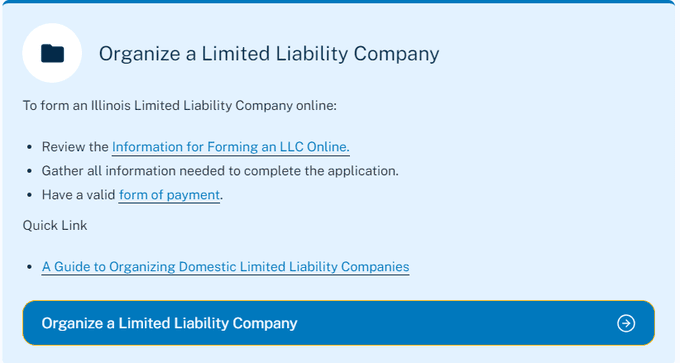
An LLC is a Limited Liability Company. It’s a business structure allowed by state statutes. For example, if you want to open an LLC in Illinois, you can simply go to the IL Secretary of State website and open one:
Depending on how many members you have, you will create a “single-member LLC”, meaning it has one owner, or multi-member LLC. If you have a multi-member LLC, it’s treated as a partnership by default and must file Form 1065, with each member receiving a Schedule K-1.
Tax treatment
Say you are a single owner and want to start a side hustle selling widgets online. If you go to your Secretary of State website and open an LLC, you’ll be treated as a “disregarded entity” by default for tax purposes. A disregarded entity is a business structure that is “ignored” for federal income tax purposes. Your single-member LLC won’t have to file its own tax return. Instead, you’ll report all income and expenses on Schedule C with your Form 1040.
In contrast, let’s say you started your side hustle selling widgets online but didn’t create an LLC. You would still report income and expenses on Schedule C with your Form 1040.
In other words, just opening an LLC does absolutely nothing from a tax standpoint for this individual. They’ll still be able to write off expenses (assuming they are ordinary and necessary in carrying on the trade or business and it’s not a hobby), regardless of whether an LLC is created or not. You’ll also pay the exact same amount of tax in a disregarded LLC structure as you would as a sole proprietor, since both are reported on Schedule C.
Note: An LLC comes with a yearly fee. For example, in California, there’s an $800 minimum fee for maintaining your LLC. In other states, it could range between $100–200 per year. This means that further analysis is needed to determine whether one should be created in your situation and how you plan to operate.
S corporation classification
As I mentioned, an LLC is a disregarded entity for a single member LLC by default. However, you could elect your LLC to be taxed as an S corporation for tax purposes by filing a form.
This could allow you to potentially save money on self employment taxes. You would have to pay a reasonable salary to yourself, and take the rest of your income as a tax free distribution.
There are circumstances where it makes sense, and others where it doesn’t. Once you elect an S corporation status for your LLC you have to:
- Pay yourself a salary, which means that there is an additional compliance cost that comes with it. You can use a payroll software, but they come with a cost (typically start at ~$40/mo)
- File Form 1120. If you use a CPA, that means additional $$$ during tax time.
- Pay FUTA/SUTA taxes
- Some states have an additional fee on S corporations
So, while an LLC could be classified as an S corporation, further analysis is needed to calculate the full tax savings after taking into consideration the compliance cost. Generally, you will likely see a benefit of choosing one after reaching $100,000 NET income from self employment.
But, just opening an LLC doesn’t accomplish that.
Legal aspects
One of the main benefits of an LLC, in situations where there is no tax difference (e.g. solo proprietor vs single member LLC, and when an S corporation isn’t worthwhile), is the legal protection.
Because an LLC is a separate legal entity, it typically protects the owner’s personal assets from business liabilities. However, this protection isn’t absolute, and the “corporate veil” can be pierced. For example, if you fail to keep business and personal finances separate, creditors may be able to go after your personal assets.
This is why it’s crucial to set it up correctly and maintain all required formalities, such as having an operating agreement for your entity. Please contact an attorney if liability protection is a concern.
To wrap it up
Here are some questions to think through if you are considering creating one:
- How risky is the business I’m operating in?
- If you are just starting out, is it worth paying the $100-800/yr fee to create an LLC?
- Am I making more than $100,000 in net income that S corporation classification for an LLC could be helpful?
An LLC is first and foremost a legal protection tool, not a tax “loophole”. It doesn’t give you new write-offs, but it can protect your personal assets and, if structured right (like with an S corp election), may reduce self-employment taxes once you’re earning ~$100,000.
As always, this post is for educational purposes only and is not legal or tax advice. Always consult a CPA or attorney for your specific situation. I hope you learned something new today.
See you next Saturday.