
Trump Account was created as part of the OBBBA signed on July 4, 2025. I’ve been getting a lot of messages about it, because there is a lot of conflicting information. The IRS has also posted some instructions for the account.
My goal with this post is to walk through the rules and give my take on when (if ever), this account makes sense.
Timing & Creation
First and foremost, no contributions are allowed in this savings account for children until 12 months after the law’s enactment, meaning you can’t use it or invest in one until July 5, 2026.
However, you can start signing up for it.
There are 2 main ways:
1. File Form 4547
You can file Form 4547 with your tax return to open an account for your beneficiary. This is the safest and easiest way to make the election to open the account.
This is also where you can get a $1,000 pilot program credit if your child qualifies (more on this in a bit)
2. File Form 4547 via TrumpAccounts.Gov
You may use the .gov website to file Form 4547 electronically:
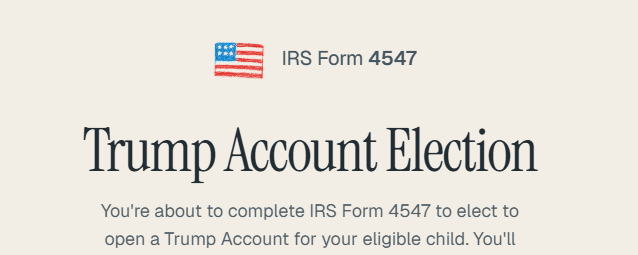
Personally, if you plan to open one, I recommend filing Form 4547 with your tax return, which I believe is a more secure way to submit the election.
General
A Trump Account is treated like a traditional IRA under Section 408(a) (not Roth), with some modifications. It is created for the exclusive benefit of an individual who:
- Has not attained age 18 before end of the year.
- Has a Social Security number.
- Has an election made by the IRS, or by a parent/guardian (the Form 4547)
Contributions
There are 2 types of contributions: exempt and non-exempt (regular)
1. Non exempt contributions
Up to $5,000/year can be contributed by parents, grandparents, or even relatives, until the child turns 18, starting in July 2026. Importantly, there will be NO tax deduction for contributing to this account.
2. Exempt contributions:
- Employer contributions: up to $2,500/year, excluded from income of the employee of the child
You may have heard about employers pledging to put some amounts in their employees accounts. Companies like Nvidia, Citi, BoA, IBM, Chase, Visa and many others pledged to contribute to these accounts for their employees’ children. This is great because it’s “free” money for them.
- Pilot program
Parents/guardians elect for an “eligible child” (U.S. citizen born Jan. 1, 2025, through Dec. 31, 2028) to receive $1,000 as a seed contribution. This is an election you can file as part of the Form 4547. Note that even though your child may not qualify for the $1,000, you can still open the account using Form 4547.
- Qualified general contributions
Governments or nonprofits can also contribute for certain minors based on some qualifications (e.g. county deposits $1,000 for all minors living in that county).
You may have seen a charitable commitment from the Dells of $6.25B. As part of the commitment, the first 25 million American children age 10 and under living in ZIP codes with median incomes below $150,000 will receive an additional $250 contributed to the account.
Exempt contributions aren’t part of the “basis” which becomes important for withdrawals.
Investments
Funds must be invested in eligible index mutual funds or ETFs that:
- Track a broad U.S. equity index
- Don’t use leverage
- Have an expense ratio <0.10%
I like this requirement because it keeps investing simple and minimizes fees.
Distributions
No withdrawals are allowed before age 18 (except for rollovers or excess contributions).
After 18, the account functions like a traditional IRA. This means that when you withdraw the money, the growth is taxed as ordinary income when withdrawn.
After the growth period (that is, starting January 1st of the calendar year in which the child turns 18), most of the
rules that apply to traditional IRAs will generally apply to the Trump account. For example, this means that
distributions from the Trump account could be subject to the section 72(t) 10% additional tax on early distributions, unless an exception applies (like higher qualified education expenses or $10k for first home downpayment)
Example
Say you, as a parent, contributed $5,000 to this account. You did not receive any tax deduction for this contributions. Your child also received $1,000 from the pilot program, since your child was born between 2025-2028. At 18, the account grew to $22,000.
- Basis = $5,000
- Earnings = $17,000
Withdrawals at 18 are pro rata. If you take $10,000 to pay for college, ~$2,272 would be from the basis (non-taxable) and ~$7,727 would be taxable earnings.
You would pay taxes on $7,727 based on the marginal tax rate. A 10% penalty will not apply, since an exception applies (see a full list of exceptions here)
Benefits
I believe the main usefulness of this account is the Roth IRA play. Of course, get the $1,000 pilot contribution or any other “free” benefits. But making direct contributions to the account may not be the best choice, especially if you are limited on funds.
For ongoing contributions, a 529 plan will likely come out ahead for most families. This is because the withdrawals are tax free for education, you can often claim a state tax deduction, and OBBBA expanded qualified expenses on 529 plans to include expenses like SAT/AP exams costs and postsecondary credentials. You can also convert up to $35,000 to a Roth IRA from a 529 plan.
However, wealthier parents may find contributing to the account and making a Roth conversion a strategic choice.
What do you think of this account? Let me know if you have any questions. You can just reply back!